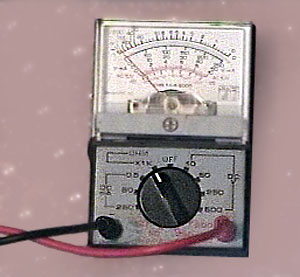
| A
multimeter is a device used to measure electrical properties such as
voltage, current and resistance. A multimeter is a multi function device
that works as a Voltmeter, Ammeter and Ohmmeter. You can switch between
these applications by turning a switch.
Testing the voltageVoltage is the difference in potential of electrons between two points. For example the difference in potential between the positive pole and negative pole of a AA battery is usually about 1.5 volts. Difference in potential happens when the concentration or accumulation of electrons in one point is more than another point. If such two points are connected to each other using a wire, the electrons will flow from one side to the other until the potential of electrons equals. Such a movement of electrons from one point to the other is called a Direct Current of electricity. To measure the voltage of a battery you set the range selector switch to any of the DCV positions, connect the black test lead to the negative pole of the battery, connect the red wire to the positive pole of battery and watch the movement or disposition of the indicator needle. Relative disposition of the needle shows the voltage. For example if you set the range selector to 10 volts DC (10 DCV) and needle goes half way and stops on the center of display, that shows the voltage of your battery is 5 volts. Display of a multimeter has different scales. It is better if you look at the scale line that is the same or closest to your range. For example if you set the range selector switch to 2.5 VDC (2.5 volts Direct Current) you can look at the scale numbered from 0 to 250. This scale is 100 times more than your range, so you must divide your results by 100. So if the display shows 175, it really means 1.75 Volts. Testing for ContinuityThis test should be done when current is NOT present. Always unplug the device or turn off the main circuit breaker before attempting a continuity test. A continuity test is done to determine whether a circuit is open or closed.
Testing for GroundThis test should be done when current is NOT present. Always unplug the device or turn off the main circuit breaker before attempting a ground fault test. A ground fault test is done to determine if current is passing from a circuit inappropriately. A ground fault is a potentially dangerous electrical shock hazard. A ground fault can also cause a device to malfunction. Set the multimeter to the ohm setting. If there is more than one ohm setting, choose X1. Touch one probe to a terminal and touch the other probe to the device's housing or mounting bracket. Now move the first probe to another terminal. If the multimeter displays anything other than a reading of infinity for any of the test combinations, a ground fault exists and the device should be repaired or replaced. Do not use a component that has a ground fault. Measuring ResistanceThis test should be done when current is NOT present. Always unplug the device or turn off the main circuit breaker before attempting to measure resistance. Resistance is how much the flow of current in a circuit is impeded. Resistance is necessary for heat to be generated in heating elements like those used in an electric stove or oven, dryer or hair dryer. It is necessary to know what the proper resistance rating should be for a particular device in order to determine if it is functioning properly. Set the multimeter to the ohm setting. Touch a probe to each of the terminals. The reading on the multimeter should change from infinity to the level of resistance detected in the element. Compare the measurement to the manufacturer's specification for the element.
|

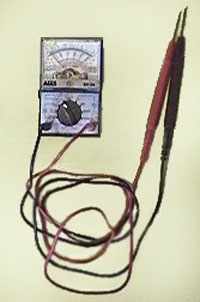
 , the Greek
letter omega. If there is more than one ohm setting, choose X1.
, the Greek
letter omega. If there is more than one ohm setting, choose X1.